

The Accelerators
The Main Event: Smarts vs. Action
The current competition is shifting from "who has the best chatbot" to "who has the most useful assistant."
Feature
GPT-5.5 (OpenAI)
Claude Connectors (Anthropic)
Primary Focus
Intelligence & Intuition. Billed as the smartest and most intuitive model yet.
Integration & Action. Integrates with over 200+ apps (Spotify, Uber, etc.).
Strategy
Betting on a model that is smarter and requires less "prompt engineering."
Betting on a model that can do things for you without leaving the chat.
Key Takeaway
OpenAI wants to be the smartest brain.
Anthropic wants to be the most capable hands.
Key Highlights
GPT-5.5: The goal here is reducing "user friction." OpenAI is positioning this model as more intuitive, admitting that previous models were often too difficult for the average person to get high-quality results from.
Claude Connectors: This update allows Claude to interact with everyday services like Instacart, TripAdvisor, and more. This moves Claude beyond just answering questions and into the realm of a functional agent that can book, order, and plan on your behalf.
In short, while GPT is trying to get smarter at thinking, Claude is getting better at working.
Since March 2026, the rivalry between Claude and ChatGPT has evolved from a chatbot war into a race for functional AI Agents and specialized coding tools.
Here are the key updates from your recent correspondence:
Major Feature Launches (April 2026)
Claude Opus 4.7 & Routines: Anthropic released Opus 4.7 alongside Claude Routines (for automation) and Managed Agents.
Claude Connectors: This new feature integrates Claude with over 200+ everyday apps like Spotify, Uber, and TripAdvisor, allowing it to perform actions like booking and ordering directly.
GPT-5.5: OpenAI launched GPT-5.5, positioning it as their "smartest and most intuitive" model to date, specifically aimed at reducing the need for complex prompt engineering.
Codex App Integration: Codex (OpenAI) can now use Mac apps by "seeing, clicking, and typing" with its own cursor to handle workflows that lack APIs.
Developer & Coding Updates
Claude Code: A new command-line tool (CLI) from Anthropic for agentic coding. Recent discussions highlight its "skills system," context pipelines, and a feature-rich CLAUDE.md configuration file.
Security & Local AI: * Replit released a Security Agent that uses AI reasoning to catch vulnerabilities in agent-written code.
Multiple guides have emerged on running Local LLMs as a cost-effective replacement for Claude Code.
Business & Productivity
Lower Pricing for ChatGPT Business: OpenAI lowered its Business workspace price to $25 per user/month (or $20/month billed annually) and introduced usage-based Codex seats.
Agent Bootcamps: New training programs, such as the "Build Your AI Agents Bootcamp" in early May, are focusing on implementing agents like Manus Agent, Claude Cowork, and ChatGPT Agent Mode for business automation.
Claude vs. ChatGPT: The May 2026 Shift
As of this month, the two AI leaders have taken very different paths.
Feature
GPT-5.5 (OpenAI)
Claude Connectors (Anthropic)
Main Philosophy
Intelligence & Intuition. OpenAI is focused on making the "smartest" model that requires less effort to get good results.
Integration & Action. Anthropic is making Claude a "hands-on" assistant that can actually do things for you.
New Abilities
Better at understanding natural intent without complex prompts; improved coding via Codex App Integration.
Connectors link to 200+ apps (Uber, Spotify, etc.) so it can book, order, and plan directly.
Developer Focus
Focus on desktop interaction (seeing/clicking Mac apps).
Claude Code (CLI) for automated software development.
What Else is New?
Claude 4.7 & Routines: Anthropic has introduced "Managed Agents" to handle recurring tasks automatically.
OpenAI Price Drop: ChatGPT Business has dropped to $25/month to compete for enterprise users.
Security Agents: Companies like Replit are now deploying specialized AI to check the security of code written by these other AI agents.

SHARED AI TECH NEWS
May 26, 2026
11:00 am EDT - 12:00 pm EDT
Upcoming Event

Image by ChatGPT
AI companion bots as a public health issue: A new framework for regulation
AI companion bots are reshaping how people connect, confide, and cope, with children and adolescents among their most active users. Even as evidence of their potential social and developmental harms grows, these products face limited regulatory oversight.
On May 26, the Center for Universal Education at Brookings will host a conversation on whether AI companion bots should be governed as a product with public health implications. Gaia Bernstein will discuss findings from a forthcoming policy brief, “From bans to recalls: A public health framework for AI companion bots.” The conversation will explore the public health risks of AI companion bots, particularly for children; why existing regulatory frameworks may fall short; how tools such as recalls and pre-market approval could apply to AI systems; and what steps legislators, companies, families, and advocates can take now to protect young users.
Online viewers can submit questions via e-mail `to events@brookings.edu.
Commentary
Pope Leo’s moral stance on AI could encourage greater oversight
Posted May 13, 2026 Reposted May 13, 2026
Pope Leo XIV chose his name in part to honor Pope Leo XIII, who led the Vatican as the world shifted to an industrial economy, and who championed workers’ rights.
The pope has implied we are in a similar era of change given the rise of AI and has warned the technology could fuel “polarization, conflict, fear and violence.”
Whether or not Leo’s words are heeded by governments and businesses, people around the world give attention to church teachings, and his views could broaden their perspectives about AI.
Commentary
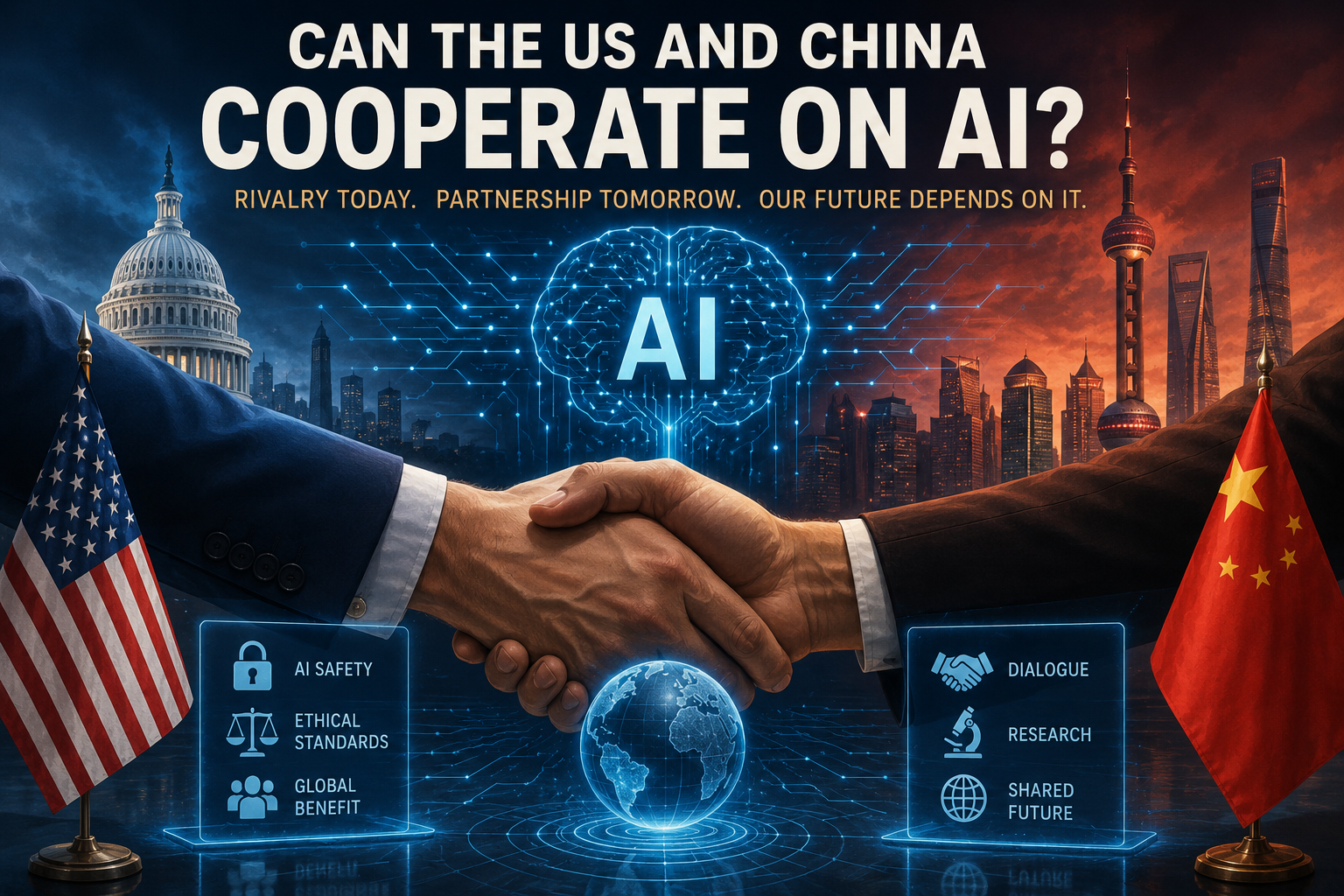
Image by ChatGPT
Posted May 8, 2026 Reposted May 13, 2026
President Donald Trump will travel to Beijing for meetings with President Xi Jinping on May 14-15. Secretary of the Treasury Scott Bessent and his team have been given responsibility for preparing for Trump’s trip. In advance of the trip, Treasury officials have signaledpublicly that Trump and Xi plan to discuss artificial intelligence (AI), and specifically, areas of mutual cooperation on “security and threats from nonstate actors.”
Research
Context-maxxing: A path to cognitive agency with generative AI
Jacob TaylorFellow - Global Economy and Development, Center for Sustainable Development
Posted May 6, 2026 Reposted May 13, 2026
AI industry debates have favored maximizing AI consumption and AI outputs. Both miss a fundamental question of whether generative AI is being deployed in ways that support human cognitive agency—the capacity for people to think and act with AI in ways that increase their control, efficacy, and mastery.
This paper codifies the rapid emergence of user-controlled, open-source AI deployments as context-maxxing, or the practice of maximizing user control over context in human-AI interactions.
User-controlled computing environments could support entirely new human expertise and capabilities for shared problem-solving with AI, raising important questions of how coordinated public investment and regulation can lower the barriers to context-maxxing for people everywhere.